
♥ Wishlist




A Milwaukee air compressor is designed for users who want dependable compressed-air performance without giving up portability. For Canadian contractors, carpenters, remodelers, tradespeople and serious DIY users, a compact compressor can make pneumatic fastening and inflation tasks easier to manage around the jobsite. Milwaukee's cordless approach is especially useful when moving between rooms, vehicles, unfinished structures or outdoor work areas where a convenient power connection may not always be available.
When choosing a Milwaukee compressor, start with the job rather than the tank size alone. The most important specifications include CFM, PSI, tank capacity, recovery time, power source and portability. CFM describes the volume of air the compressor can deliver, while PSI indicates the pressure it can produce. A compressor may have a high maximum PSI rating but still be unsuitable for a demanding pneumatic tool if its delivered airflow is too low. Always compare the compressor's published airflow at a stated pressure with the requirements of the tool you intend to operate.
Milwaukee is well known for its cordless M12 and M18 platforms, and its portable compressor options are a natural fit for tradespeople who already use compatible Milwaukee batteries. Cordless operation eliminates the need to position the compressor near an electrical outlet and can reduce the hassle of extension cords when working across a busy jobsite. For professionals who already own M18 batteries and chargers, platform compatibility can also simplify equipment management.
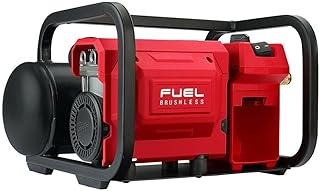
One notable option is the M18 FUEL 2 Gallon Compact Quiet Compressor. Model 2840-20 is a compact, oil-free compressor with a 2-gallon tank and a published noise level of 68 dB(A). Milwaukee specifies airflow of 1.2 CFM at 90 PSI and highlights its suitability for professional carpentry and remodelling applications. Its low-profile, stackable design is useful when transportation and storage space matter, while the single-turn regulator makes pressure adjustment straightforward.
Compact compressors can be particularly useful with pneumatic brad nailers, finish nailers and staplers because these applications typically use compressed air in short bursts. A portable Milwaukee compressor can provide a practical combination of mobility, pressure and recovery for trim carpentry, cabinetry, remodelling and other fastening work. Check the nailer manufacturer's recommended PSI and air consumption before buying.
If your compressor needs to move frequently, consider more than its listed weight. Handle design, footprint, balance, battery placement and stackability all affect day-to-day convenience. A compact cordless compressor can be easier to position close to the work area, particularly during renovations where electrical access is limited or inconvenient.
For intermittent inflation tasks, portability may be more important than having a large air reserve. However, shoppers should distinguish between a true tank compressor and a compact inflator. A Milwaukee compressor intended for pneumatic tools should be evaluated according to its airflow and operating pressure, while a dedicated inflator may be better suited to tires and other low-volume inflation jobs.
CFM and PSI measure different aspects of compressor performance. PSI tells you about pressure; CFM tells you about delivered airflow. For tools such as grinders, sanders, air hammers and some spray equipment, airflow can become the limiting factor because these applications may consume air continuously. By contrast, intermittent nailers and staplers may be well matched to a smaller portable compressor.
Tank capacity is also important, but it should not be the only specification you consider. A larger tank stores more compressed air and can help reduce cycling during intermittent use, but it does not replace adequate compressor output. For mobile construction work, a smaller compressor with the right airflow may be more useful than a substantially larger unit that is difficult to transport.
Before ordering, confirm whether the product is sold as a tool-only unit or includes a battery and charger. If you already have compatible Milwaukee batteries, a bare-tool compressor can be a convenient way to expand your existing system. If you are starting from scratch, include the cost of the required battery and charger when comparing the total purchase price.
Canadian shoppers should also check the current retailer price in CAD, stock status, shipping availability, warranty information and return conditions. Product specifications can vary by model and market, so verify the exact model number before purchasing. For demanding pneumatic applications, compare the compressor's airflow with the tool manufacturer's requirements rather than choosing solely on brand, tank capacity or maximum PSI.
Whether you need a portable compressor for finish carpentry, remodelling, fastening or general jobsite use, the right Milwaukee model should match your actual air requirements and working environment. Prioritise airflow, operating pressure, portability, battery compatibility and noise level, then compare the available models and current Canadian buying options. With the right specifications, a Milwaukee air compressor can provide a practical balance of cordless freedom, jobsite mobility and compressed-air performance.
Find a Milwaukee air compressor for portable compressed-air performance on Canadian jobsites, workshops and renovation projects. Compare compact cordless options, tank capacity, airflow, pressure, noise and battery compatibility to choose the right compressor for your application.